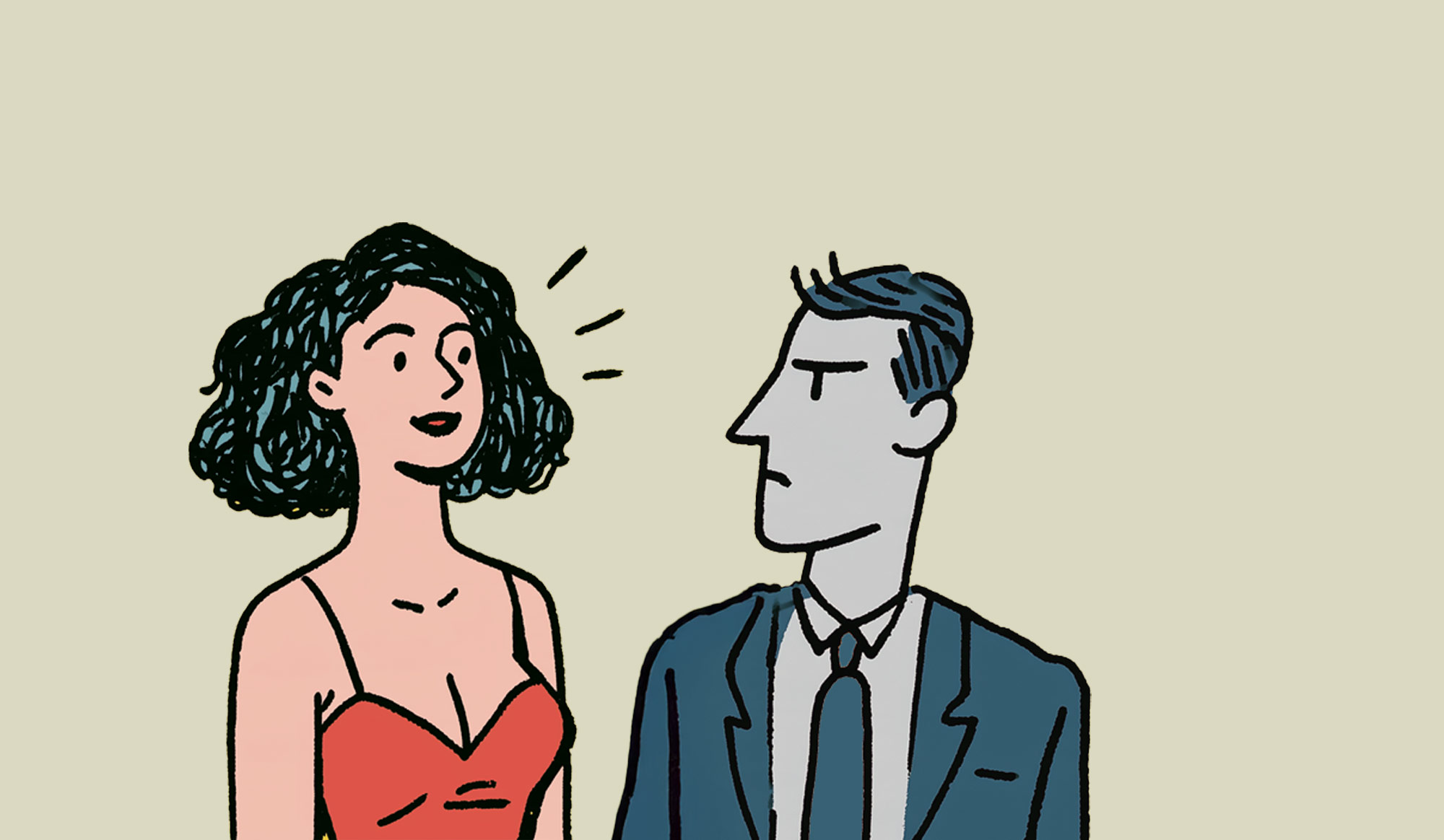
Ed came to see me with “a possible case of retroactive jealousy”.
“But I don’t know,” he said. “If I’m having to lower my standards to be with my girlfriend, to accept certain things about her past… is that really my retroactive jealousy?”
It’s a fair question.
Ed had seen two therapists already (and spent a fair amount of money) and still wasn’t sure. His girlfriend persuaded him to have one more try. She was worried about him.
His mood was erratic; he had flashes of anger about “having to accept”, followed up with apologies and feeling really bad about himself. He wasn’t sleeping either.
“It’s my values, my standards”
He told me his views about casual sex, one night stands and easy women.
“People can do what they want, but I don’t want to be with someone like that. It disgusts me, it gives me the ick.”
And his girlfriend had had “2 or 3 experiences” like that. “She’s amazing, a really good woman,” he said, “but this stuff has me pushing her away and berating her for it. We can’t go on like this.”
“She’s not doing anything wrong. But it’s my values, my standards. I didn’t sign up for all that, I’m sorry.”
Two therapists, two approaches
“So Ed, what did the other therapists say?”
“The first one jumped straight onto my values. She said I needed to be more accepting and tolerant. To change my beliefs about casual sex, basically.”
“Right OK, what about the other therapist?”
“This one was a man, and he said I’ve got retroactive jealousy. And we needed to work on me staying grounded when I have these thoughts.”
“How did that go?” I asked.
“I get it, I know I can be a bit difficult at times”, Ed said. “So we did breathing, and reminding myself of the positive things about my girlfriend, how good this relationship is. And we did this thing where I pictured the thoughts of what she did… passing along like leaves on a stream.”
“But I found it really hard to shift this… disgusted, sick feeling. And even the real, positive things make me feel it.”
“What do you mean?” I asked.
“Like when she’s dressed up and looks amazing, or we’re doing something really fun together. My mind goes – yeah but other men got that, they got full access. You know what I mean? So when even the positive goes against my values, and makes me feel… repulsed, that’s got to be telling me something? It’s not just thoughts is it?”
Why I leave values out (at first)
A couple of thoughts from me. I can see what the first therapist was getting at with “Ed, you need to be more accepting”.
If your values are causing the thoughts and the disgust, it makes sense to question them. But I’m not sure Ed’s values are the cause. I think his disgust starts somewhere else.
I tend to leave values out of retroactive jealousy therapy (at first, anyway). A real clash between two people’s values has a tipping point. You decide it’s not for you and you leave.
Retroactive jealousy doesn’t have that end point; it loops. Maybe you leave the relationship and it still loops, and you go back to her or him. Because you haven’t really acted on your values, you’ve acted on a doubt.
What I’m hearing from Ed is he really doesn’t want to be in a relationship with someone who’s ‘easy’, promiscuous, “just gives themselves away” as he says. I don’t think that’s that unusual or unreasonable, really.
There’s something else going on that’s making him so angry about his girlfriend’s past.
The second therapist was working more downstream. “OK you’ve had a thought and a bad feeling, but now you can calm that feeling, and let the thought pass – or replace it with something more positive. Then you won’t have this fight-flight response, lashing out at your girlfriend or pulling away from her.”
Sometimes, this kind of mindful approach is genuinely helpful.
But for Ed, and quite a lot of people who try it, not really. His mind pushes back: “but I still don’t like what she did” and it has a point – he doesn’t.
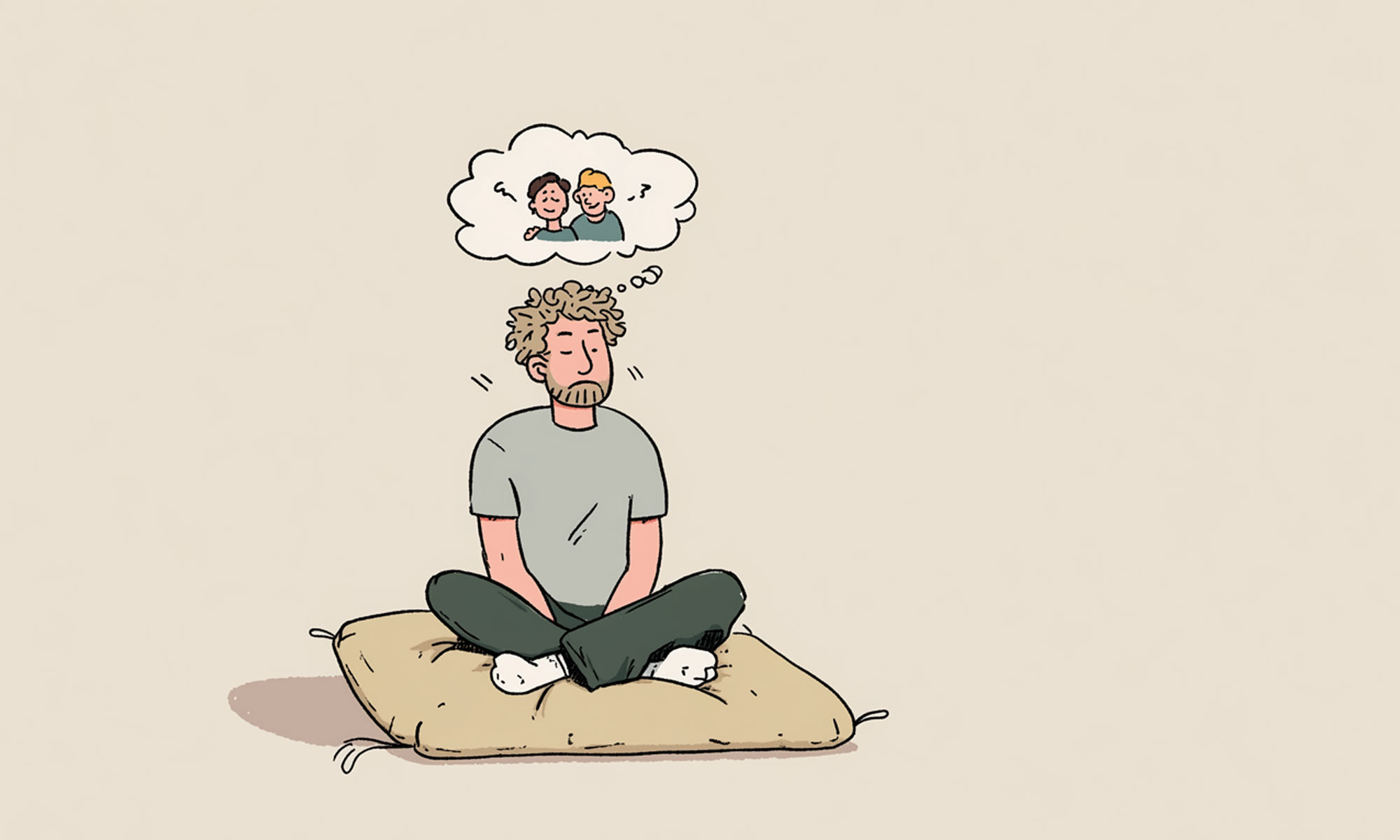
He might be calmer, doing his breathing, being less reactive. That’s good. But her “2 or 3 experiences” are still looping in his mind, even looping on the positives. “There you go, she’s incompatible with your values”, his mind says.
Let’s look upstream now. Not at Ed’s values, but at his doubting and his reasoning.
From “she looks great” to “what if?”
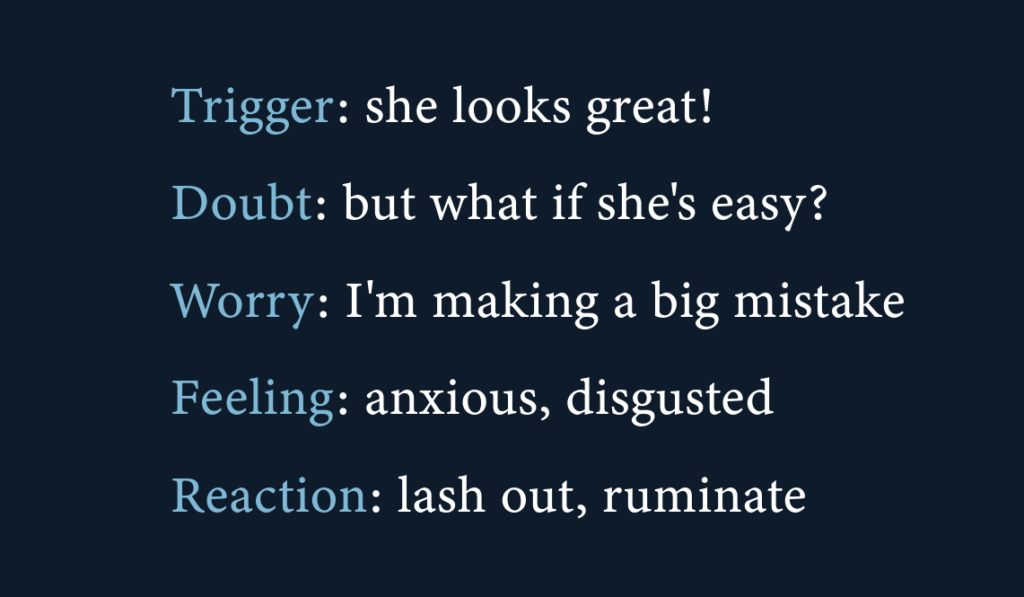
Here’s an example of how Ed’s retroactive jealousy plays out:
Maybe he and his girlfriend are getting ready to go out, she scrubs up really well.
And he looks at her and thinks “wow she looks great” – and his brain adds on “yeah and she probably looked great when she gave herself away to those other men, don’t forget”.
That thought springs from doubt, and it’s set him off again. His girlfriend looks great, they’re going out, but: what if this girl I’m with is easy, promiscuous?
If she is, I’m making a big mistake, this is all wrong, OMG what am I doing?
Note that word DOUBT. Ed hasn’t come to me and said, “Jason, I’m here because my girlfriend IS easy and promiscuous and I need help with that.”
He’s actually come to me and said she’s “amazing, a great partner”. That’s not easy and promiscuous is it?
But it’s the doubt in these moments that torments him: but what if she is?
And his imagination runs with that: now he’s looking at her dressed up and looking great for another guy, for a casual encounter. His mind is time-travelling backwards and he feels anxious, stressed, conflicted and yes, disgusted at what he ‘sees’.
Hence the urge to lash out and make a comment about her past, or go quiet and distant, or ruminate on it for the rest of the evening. He’s trying to do something to shift these horrible feelings.
His mind has done a number on him, again.
“On what basis is it true?” and RJ’s three reasons
But here’s the thing. If I say to Ed “so on what basis is it true – on what basis is your girlfriend an easy, promiscuous woman who’s all wrong for you?”, he’ll say “well she did those things, one night stands or whatever, she told me, I know that for a fact.”
That’s what he said when I asked him. But he can see the bridge from past to present that his imagination has built here.
If he was sure those things tell him everything he needs to know about her, he’d check out of the relationship and be done with it. That’s his prerogative.
Ed sees the gap. “So why is it true then?” I ask.
“Well, it’s possible” he might say. “There are easy, promiscuous women out there – fact.”
Maybe he’s met some, or knows some or has heard the lads talking about them. Maybe he’s been hurt or let down before. Maybe leopards don’t change their spots, casual sex in the past means she’ll always prefer casual sex.
It’s possible. But possible isn’t the same as true or evidenced.
He could end the relationship based on that possibility, but he sees the gap there too. How often do we arrive at significant decisions and make significant changes based purely on possibility?
We’re not arguing with his reasoning here, just pointing out the gaps. There is no evidence.
“So what means it’s true then?” (I know, I’m quite an annoying therapist.)
“Well, it’s my values.” Here we are. “I really don’t like it. Each to their own but that’s not for me.”
Do you see the gap there? Do you see why saying “Ed, maybe loosen up those values a bit, it’s not that bad, don’t be so judgemental” is missing the point?
He doesn’t need to change his values or expectations at all. He just needs to recognise that his values don’t make the doubt – what if my girlfriend is easy and promiscuous? – any more true.
In fact, asking him to adjust his values has the opposite effect. He hears it as “you have to change your values so you can be with your promiscuous girlfriend”. That’s validating his obsessional doubt and perpetuating his worry.
His reasoning process in moments of doubt is recruiting his values as evidence. And it’s persuasive because they are his values, and she did have those experiences, and anything is possible. But it’s still a doubt without evidence.
What would be evidence that his girlfriend is easy and promiscuous and all wrong for him?
Maybe… she cheats on him or shows signs of cheating on him? Or she really likes telling him about the one night stands she’s had, she comes alive when she talks about it (she doesn’t btw – she hates it when he brings it up).
Or she… compares him to those guys, says she’s had better, laughs about it, gets off on it.
“Is any of this happening in reality?” I asked Ed. “No, it isn’t” he said.
Keep your values, ditch the doubt
Ed doesn’t need to picture leaves floating down a stream. He can get really clear that his doubt is imagined: his mind is knitting together bits from the past, what other people say or think, possibility and what his values say about casual sex.
When he gets really clear on that, there’s nothing to calm down about. Because it’s imagined; it isn’t happening. He has sensory, here and now evidence of that. She’s great, a really good partner.
Now I’m summarising several therapy sessions with Ed here. But see how we went upstream, before the fear and disgust, right up to the doubt and the reasoning.
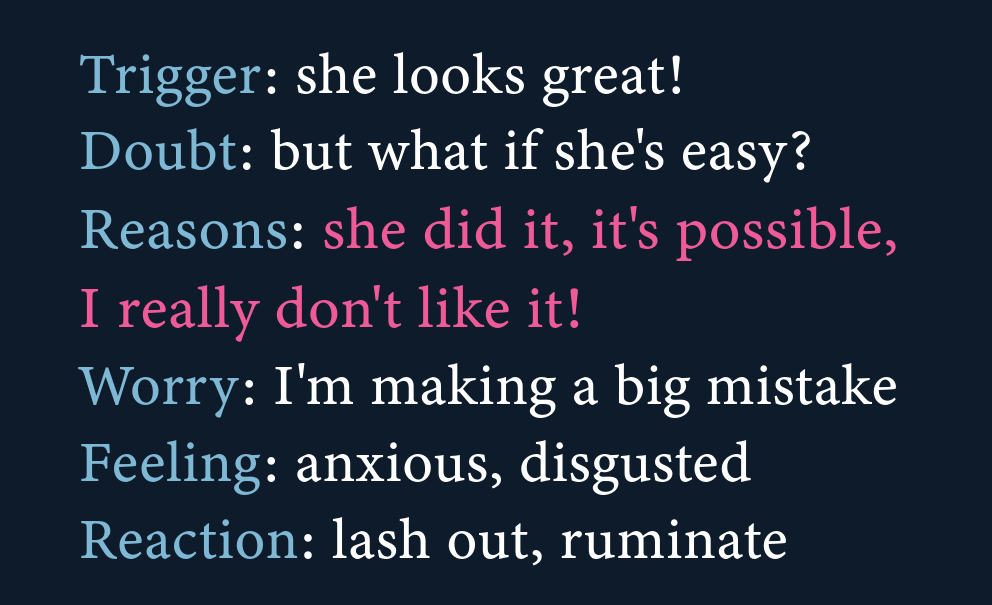
We can’t do anything about the trigger – his girlfriend looking good when they go out. (“erm… babe could you look a bit more frumpy please? That would really help me right now…”).
But we can break the spell and see his doubt for what it is: an imagined possibility with no real evidence. And Ed can be certain of that.
If you find yourself in a similar situation to Ed, try the same question: on what basis is it true right now? That your partner is this or that.
And notice which of retroactive jealousy’s three reasons you get. She or he did it in the past, it’s possible, it’s my values, I just don’t like it.
But is it happening? Is it evidenced or pieced together in my imagination?
That makes it sound so easy, I know. In reality, a sticky, doubting mind pushes back. It might try generating other what ifs. We might not be used to trusting what we see, hear, know of the partner in front of us.
But by seeing this sequence, this cascade of doubt, reasoning, feelings and reactions – we see the loop of retroactive jealousy for what it is. Obsessional doubt that recruits our logic and our imagination and our values to make a possibility feel horribly compelling.
“So… I don’t need to change my views about casual sex then?” said Ed.
“I don’t think so” I said.
Obsessional doubt was the problem here. Resolve that and you get to keep your values and your girlfriend. What’s not to like?
I hope this is helpful, and if you’d like to understand more about breaking out of your own loops of doubt, reasoning and reaction, see my online course linked below and my other videos.