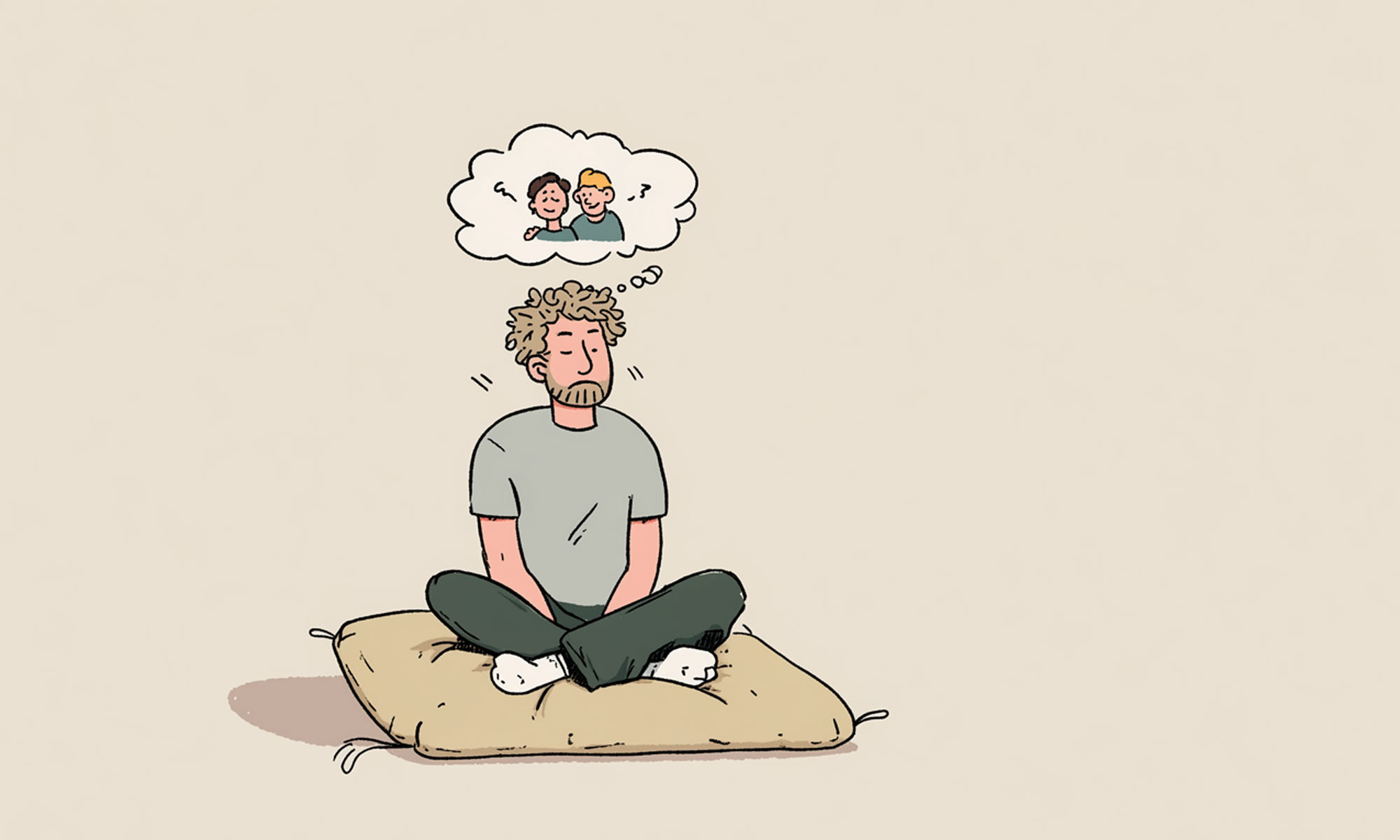
When Tom came to see me, he’d already worked on his intrusive thoughts. Two months of daily journalling and meditation. Making time to sit every morning, focusing on his breath, being present.
He was following the advice in a popular retroactive jealousy self-help book. The book said meditation is the most effective technique for overcoming thoughts about your partner’s past.
But here he was, in my therapy room, still struggling.
Tom and his girlfriend are in their mid-20s. She’s had a couple of relationships before him, and some experiences when she was at university.
He can’t stop thinking about it, especially the stuff when she was a student. The mental images “do his head in”, he said to me.
He hoped that daily meditation would help quieten all this down.
To be fair to that book (which I actually reviewed in another post), the advice isn’t wrong. Learning to tune into the present moment, the reality of the here and now… that’s genuinely good practice.

Meditation has benefited millions of people for thousands of years. I’m not knocking it.
But something wasn’t working for Tom. And as he told me more about his sessions, I started to understand why.
When meditation makes it worse
Tom sits down, closes his eyes, focuses on the rise and fall of his breath. Thoughts come and go, and then a thought about his girlfriend’s past rocks up.
A mental image, and he feels the discomfort and disgust that comes with it.
The advice is to really observe the present moment when that happens.
But that’s hard, Tom said. Because the thought is an image, a vivid picture of her having sex with another guy. It’s detailed, active – and often quite pornographic.
I try to focus on my breath etc, but this image is really distracting – in a horrible way.
So then I do something I got from a mindfulness app, Tom said. I imagine placing the thought on a cloud, and just let it be there, let it float away on its own.
This is a common meditation technique. It’s part of Acceptance and Commitment Therapy, often called ‘cognitive defusion’. Again, I’m not knocking it.
But this cloud, with his girlfriend having sex on top of it, doesn’t float away. It sticks around, just like it does when it pops into his mind during the day.
So I just try to relax, observe, Tom says. Until the 10 minutes are up. It doesn’t feel great.
Yes, it all sounds a bit difficult, I said.
And I think we see the problem here. That thought, that image, represents a very uncomfortable doubt.
A doubt about his girlfriend’s past, about what it means, about how he compares. And it’s vividly graphic. Tom has a very visual imagination.
As Tom observes it, even placed on a cloud, he’s watching the show. 10 minutes a day of that is breathing more life into the doubt.
And when the meditation session ends, he’s left with the feelings plus the added discomfort of ‘is this working? I’m not sure it is, maybe I’m not doing this properly, maybe I’m stuck with these thoughts…‘.
That’s not a failure of meditation, or a failure of Tom’s. I think it’s a common problem with trying to use meditation for the vivid mental images and movies that retroactive jealousy likes to serve up.
Inward focus vs outward focus
Here’s my take on it. The version of meditation that has an outward focus, that’s useful here.
Tuning into the here and now. What can you see, hear, feel, sense right now? Getting your attention pointing away from your imagination and back into the actual, observable moment you’re in. That’s useful.
The version that has a more inward focus – eye closure, observing your thoughts, letting them move along or stick around – that’s great for general stress, and for being less reactive to day-to-day worries.
But retroactive jealousy thoughts are generated from within. From a story your imagination has built around your partner’s past. With powerful visuals and special effects.
Observing these thoughts, even on a cloud – it’s hard not to get our attention grabbed.
If we’re not careful, these kind of meditation sessions turn into rumination with candles. We’re watching the show, buying into the story even more.
The real work: understanding the doubt
So should Tom give up his morning practice? Not necessarily. But I suggest he keeps it simple. Stick to the outward focus, the mindfulness bit.
Maybe try it with eyes open, walking, still noticing his breath and the detail of the world around him. If a thought comes up about his girlfriend’s past, it might be easier to stay grounded this way.
The essential realisation for people who struggle with retroactive jealousy is that we have choice whether to engage with mental images and movies or not. We don’t need to push the thoughts out, but we don’t need to observe them either.
Observing the images and movies is a reaction to the doubt. It’s compulsive, as if it’s our only choice.
And that’s what we’re going to work on in therapy: Tom’s doubts about what is girlfriend’s past means. His story about it, why it feels so consequential. Why does her past feel so troubling or threatening – or even relevant?
That’s the therapeutic work. Meditation can help support this, but it’s not the most effective way to overcome retroactive jealousy. Or any other kind of OCD or obsessional doubt, in my opinion.
We will engage Tom’s imagination in this work. Through some creative exercises, and I’ll give him a visualisation technique he can use in those day-to-day moments when retroactive jealousy thoughts pop up.
A way to stay grounded and gently, effectively not go into the bubble – not watch the show, ruminate, come up with questions for his girlfriend, etc.
To help him fully realise the choice and the agency he has. Even when thoughts come out of the blue.
All of this takes the pressure off his meditation sessions ‘working’. That worry – did it go well, are the thoughts shifting? – is more fuel for the RJ doubts.
If meditation is helping you feel calmer and more grounded in general – great, keep doing it. But if you’re sitting with RJ thoughts and not necessarily feeling any benefit from it, that’s worth looking at.
Tom got back on track too. A week later, he said something I think hits the nail on the head: I think I was using it to try to fix the thoughts. And that was kind of exhausting.
If this resonates with you, identifying your retroactive jealousy doubts could be your best next step. I hope this is helpful.