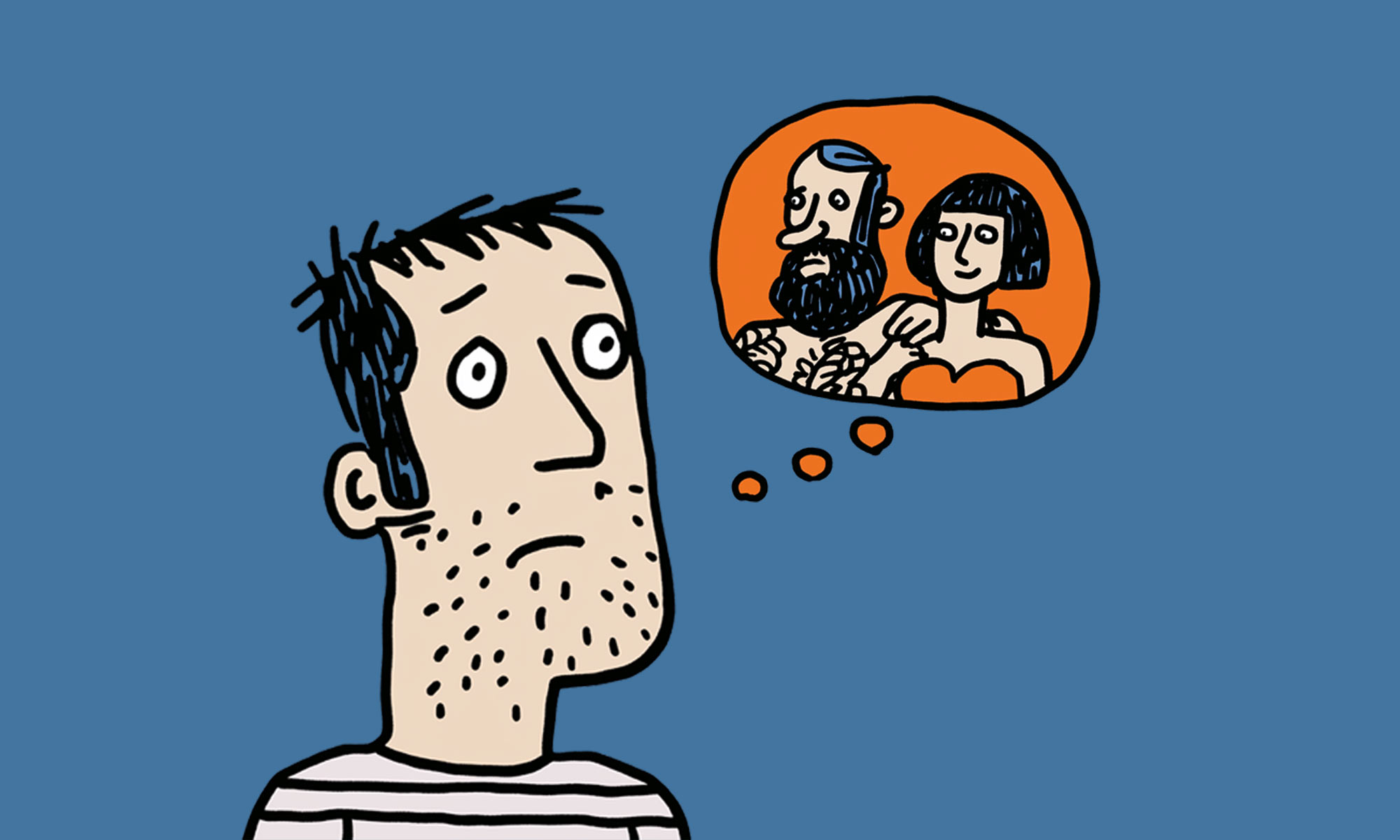
Rick was having intrusive thoughts about his girlfriend’s sexual past.
So in our first therapy session, I asked if he could give me an example.
“Oh easy”, said Rick. “Like, I’ll see a guy in the street… tall, masculine… and it just flashes in my mind: would she have had casual sex with him?”
“And then I have this mental image… her and him getting it on. In graphic detail, it’s a movie sometimes. And then I can’t shake it…”
“So seeing a guy of a certain type makes this connection to her past, in your mind?”
“Yeah 100%”, said Rick. “Or my mind just goes there anyway. Like I woke up this morning and I immediately had this thought of my girlfriend with a guy I KNOW she slept with. So it’s a real guy, a real experience she had right there in my mind.”
He looked at me. “I can’t be starting my days like this. Can you give me a technique or something, a way to stop having these intrusive thoughts?”
Now even as a therapist who works with thoughts and retroactive jealousy and OCD, I can’t give him a technique to stop these thoughts.
People try tricks and techniques. Snapping an elastic band on themselves or saying NO! every time the thought pops up. But it doesn’t work. And you feel nuts doing it.
What about techniques for rolling with thoughts? Mindfulness, urge surfing, dropping anchor, etc? These things are useful, they might help. But they aren’t enough.
I don’t want to say to Rick “sorry… I haven’t got a technique for that.”
So I say “actually Rick, what you’re describing… I don’t think these ARE intrusive thoughts.”
And that doesn’t land well.
Rick looks even more unhappy. “What? You mean these thoughts are real then? Like I’m thinking them for a reason?”
I try to be a bit clearer. “You don’t want these thoughts about her past and other men, of course. So they feel intrusive. But they aren’t just forcing their way into your mind. You’re actually generating them, from the inside.”
“But why would I do that?” he says. “Why would I make myself have thoughts that I hate?”
“You’re not coming up with these thoughts and images to torment yourself”, I said. “Or to spoil your relationship. But you ARE doing it – and that’s actually good news.”
“I can’t give you a technique to just stop doing it today, but we can get you to that point. It’s actually quite doable.”
Rick looks slightly more hopeful but not convinced. And I don’t blame him.
By the way, I don’t just say “actually, these aren’t intrusive thoughts” in a first session any more. It sounds pedantic, I know. It’s true though.
What intrusive thoughts actually look like
For the record, intrusive thoughts are a thing. We have them.
Out of nowhere, ping. What if I jumped off that ledge? What if I pushed that person over? Maybe an image of me doing it. And it doesn’t feel good.
I had one recently. I was just leaving a busy coffee shop. As I made my way past the other customers, there was a woman with her dog on a lead. It was a greyhound, just standing there.
And the thought popped into my mind: what if I grabbed that dog’s ass, with both hands, and squeezed?
I came out the shop and thought: what was that about?
But what about thoughts that keep repeating? Thoughts we can’t just brush off with oh just a thought or wow that was weird.
They get sticky and we start looking for meaning.
What if I want to jump off a ledge? Maybe I’m the sort of person who could lose control, who could attack a random stranger… or grab a random dog’s ass in a cafe?
What if I’m attracted to that idea? Now it feels really bad.
And coming back to Rick: what if she would have had sex with him? What if she HAD sex with him?
And the other places his thoughts go. What if she liked it? What did she like about it? Was else did she get up to? Why did she go for it with guys like that?
A barrage of intrusive thoughts that we have no control over? A random thought that got stuck? An overreaction to thoughts that other people just brush off?
No, there’s a better explanation than that.
And like I said to Rick, it’s good news that he’s generating these thoughts. Well, better news anyway.
Rick’s obsessional doubt
A bit more about Rick: he got hurt, a few relationships ago.
It was actually his first proper relationship, and she cheated on him. He didn’t find out until her friend sent him a FYI message. That whole experience stuck with him, of course it did.
He’d always had a few confidence issues with girls, and that experience did not help.
When he eventually dated other girls, he had this need to fully know their past. How many, who were these guys, what were they like?
“But it’s more intense now with this girl”, he said. “I try not to ask, but the thoughts – what about him, it could have been him – they’re relentless.”
What’s going on?
We both established that Rick doesn’t want to get hurt or cheated on again. Of course.
But he’s not having sticky thoughts about being cheated on. And he doesn’t compulsively ask her whether she’s cheating or attracted to other men now.
The thoughts and the questions are about what his girlfriend did before he knew her. That’s what feels so repellent and distressing.
So we kicked around a few ideas to see what his actual doubt is.
“What would have to be true or happening for her to cheat on you?” I asked.
“Well… I wonder whether she prefers a different type to me. That guy that I know about, for example. He was tall, lanky, tattoos… totally different to me.”
There’s a doubt right there: what if my girlfriend really prefers tall, lanky, tattooed men to me?
If she does, she’ll cheat on me or leave me. If she doesn’t prefer that type to me, she won’t.
That’s the logic driving the doubt, and the need to test it all the time.
“And it IS a doubt”, I said. “You don’t know your girlfriend prefers that type to you, do you?”
“No I don’t KNOW,” Rick said. “But what if she does? It’s possible…”
The doubt picks the trigger
Like all obsessional doubts, this possibility is always somewhere in Rick’s mind.
And it selects the triggers: tall men in the street. There’s one – what if she would, what if she did?
And then an image, or a movie, of her enjoying it – preferring it. The image absolutely represents his doubt.
So you see what I mean about these thoughts not being intrusive? They are coming from within, generated in his imagination by the constant doubt.
And the mental images that follow reaffirm his doubt – and make Rick feel like he’s getting closer to a horrible truth.
Hence another urge to ask, or look up that guy he knows about on Facebook again. He’s been doing that quite a lot; the guy was tall, with tattoos. It feels like further evidence. But he’s doing it.
Rick’s doubt has him constantly vigilant for proof: these other men. It’s a doubt, a narrative, about preference, types of men and rejection.
And he’s had it for some time. Ever since that bad experience, and probably before in some form or another.
So Rick starts to see how his doubt got made. Is there any here-and-now evidence that Rick’s girlfriend prefers another guy based on type?
That’s where we go next in therapy with Rick. He’s not seeing evidence, he’s manufacturing it and then treating his own manufacture as if it needs paying attention to.
Receiving it, or generating it?
A few sessions in, Rick also started to see how these thoughts get stopped. It’s not about trying to stop them, or trying to stop generating them.
It’s about stripping away the meaning from these thoughts. It might start with a simple question, the next time the ‘what if’ and the image shows up: am I receiving this, or generating it?
That question alone won’t shift or resolve the doubt. But it interrupts the automatic slide from thought to proof to truth. It gives you a half-second of distance before the bad feeling takes over.
From there, we go to work on dismantling the doubt itself. Downgrading it back to what it really is: a ‘what if’ about what his girlfriend prefers.
An imagined possibility – she might prefer a different type – that lacks any actual evidence. And has Rick doubting the reality right in front of him: they enjoy an intimate, sexual connection with each other.
This is a process of therapy. We address the self-doubts too, the sexual confidence and lasting-attractiveness doubts that Rick has.
The same applies: understanding how he arrived at these doubts, but is there any evidence apart from a bunch of thoughts and feelings? Seeing the same tricks of the mind at work. Seeing how it overrides the real evidence right in front of him.
Dismantle the doubt and we take away the meaning from all these thoughts. A tall, masculine, tattooed man on the street or in the gym… is simply a tall, masculine, tattooed man.
Even when Rick’s mind makes the old connection – and it will sometimes, out of habit – it holds no meaning. It’s irrelevant to Rick, his girlfriend, his relationship. Nothing to see here, nothing to doubt here. End of.
The mind’s creative response
Dr Frederick Aardema, a leader in OCD research and therapy, puts it like this:
These thoughts are not revealing a hidden truth; they are the mind’s creative response to doubt. The problem is not the thought itself, but the belief that it matters when in fact, it’s the mental echo of an obsessional story.
(Resolving OCD, Mount Royal Publishing)
If you struggle with retroactive jealousy and all the thinking and rumination that comes with it, I hope it’s helpful to recognise that you’re not having intrusive thoughts.
It’s not just this annoying therapist being pedantic. Seeing how the thoughts are made by the doubt gives us something we can actually work with that has a profound, lasting effect.
Rick is there, by the way.
“It got old”, he said, “in a good way. Her past still comes up in my mind sometimes, but it’s fleeting and I don’t need to do anything to move it on. It just doesn’t matter, it’s boring even. Same for the thoughts about myself and different types.”
When your doubts and self-doubts are stripped of meaning to the point of being boring, you’ll know that you’re there too.