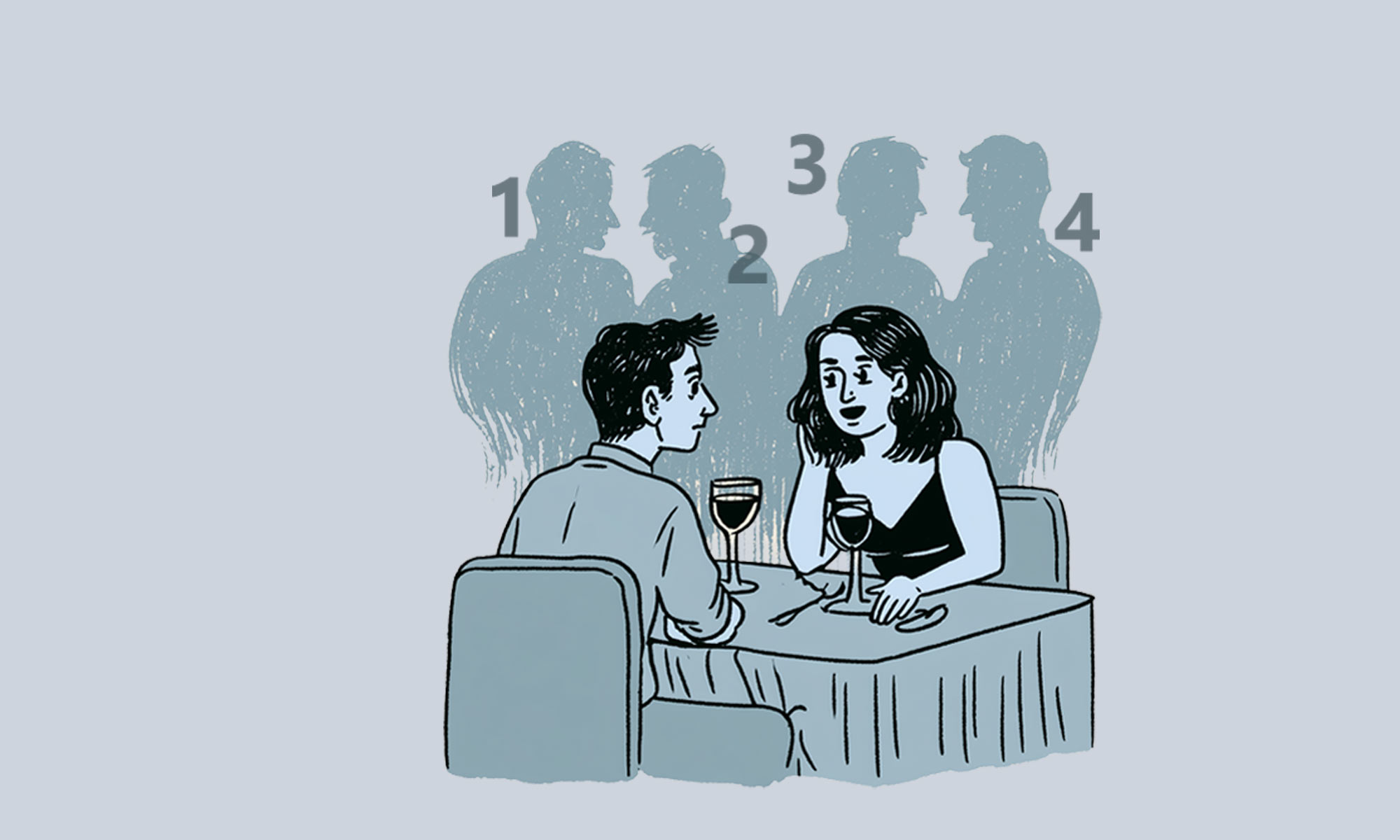
Richard’s dilemma
Richard reached out to me with a dilemma. All his relationships so far had crashed and burned due to his retroactive jealousy.
He was well aware of the pattern. He meets a girl, it’s all good and then either he finds out something about her sexual past that he doesn’t like OR she seems too good to be true and he goes digging into her sexual past and inevitably finds something he doesn’t like.
Either way, his mind locks on to her past and won’t let go.
“It’s like I see her through this filter now, of what she’s capable of” he said, “which is unfair, I know.”
A woman he recently broke up with tried to give him some constructive advice.
“You’re a good guy” she said, “but you can’t keep sabotaging yourself and hurting others like this. You’re nearly 40 years old, you need to get a grip of your jealousy.”
Richard welled up telling me this and I could see why; it’s honest and pretty spot on feedback.
And it did lead him to read a couple of books about retroactive jealousy and start looking into therapy, hence his chat with me.
But there was a curveball too: he’d already met someone else.
This happens quite easily for Richard – he’s likeable and successful. They’re not in a relationship yet but talking. And Richard is pleased but also worried, for obvious reasons.
“What do you think I should do?” he asked me. “See this as an opportunity for a fresh start, to really get a grip on RJ this time? Or hold off, and potentially lose her, so I can really work on this?”
He asked another good question too. “Can I really work on this when I’m single? I don’t really know how that would work.”
New relationship, or good working order first?
This is a dilemma. Generally speaking, there are two ways of looking at it.
To quote sex and relationships advice guru Dan Savage, we need to be in good working order for a relationship. Otherwise, we just repeat the same mistakes over and over.
Or to quote Dan again, a bit more bluntly: some people need a therapist, not a boyfriend or girlfriend.
Relationships don’t fix people and each partner needs to have a baseline level of good working order.
I can’t help thinking this as I hear about Richard’s situation.
On the other hand, relationships don’t fix people but they do grow them. Renowned therapist David Schnarch would call good relationships “the people growing machine”.
It’s more like going through a grinder at times, but a more adult version of us comes out the other end.
And even retroactive jealousy can be seen as a growth opportunity, if we really step up to it. But we need that solid foundation to grow from.
It’s a different kind of obsessional doubt, but there’s an analogy I sometimes use. Let’s say I land my dream job as a prison warder (I know, each to their own). But I have persistent doubts about security and leaving doors open.
Am I ready to take that dream job? Will it make or break me?
Maybe all those doors every day will force me to get over my fears and hangups, it’ll be good for me.
Or maybe it’ll be a living hell, constantly checking and worrying about doors and security.
And what if I really do screw it up and murderers end up roaming the streets because of me? hmmm.
If I have persistent doubts about my partner’s past, or keep comparing myself to my partner’s exes, or I have unrealistically high standards and subscribe to the myth of the one… am I ready to partner up?
Especially with someone who ticks all the boxes but has a past.
And of course, every time things crash and burn, what happens to my self-esteem and my hopes for ever holding down a relationship?
How do we know whether we’re ready to take the plunge again? Or when is staying single a form of avoidance?
It’s difficult, isn’t it. Richard and I considered a couple of indicators.
Want to or have to?
Your values can be a guide here.
Take the prison warder job. If that really is my dream job, I have something worth working towards. But if I feel I need to take the job in order to prove I can do it or to get over my security fears, this is a problem.
I’ve spoken with people who had a succession of painful relationships, all linked to RJ. Yes they wanted to have a relationship, but they also felt they needed to prove they could. So they just kept trying, for fear of failure.
“But what if I can’t really work on this outside of a relationship?” Richard asked. “And then I lose her as well?”
I was quite clear on that: we can absolutely start that work while we’re single.
Because the therapy isn’t really focused on the detail of our partner, what they did or didn’t do, their sexual past, etc.
It’s about the thought patterns, beliefs and reasoning that we keep bringing to it. And they are constant, they are what’s keeping us stuck.
The challenge, though, is staying motivated. It’s too easy to let ourselves off the hook when we’re single, kick the can down the road, hope for the best next time.
A good therapist can help keep the work on track: helping you to get clearer on what you actually value and who you want to be in a relationship.
And to get clearer on what the retroactive jealousy doubts are trying to achieve: feeling secure, safe, knowing that you’re definitely with the right partner – which is all good until it turns neurotic and judgemental and impossible to live with.
A good therapist can help you work on all that without having to involve a new partner in the project.
“So maybe there’s a case for not getting into this relationship right now?” said Richard.
“Maybe” I said. He looked a bit sad about this, of course.
“There’s a way to honestly convey that decision to her if you take it” I said. “You don’t need to go into detail; I’ve had a few struggles on my side, and I want to work on myself a bit.”
Richard can have a realistic timeframe too – a few months, say. We can actually do quite a lot with RJ thoughts and gain a lot of clarity in that time.
Trying hard vs doing the right work
I speak with people who’ve tried really hard to make their relationships work.
They tried not to think about their partner’s past (even agreeing with their partner to not talk about the past).
And they tried to stop themselves from interrogating their partners, or snooping on social media, etc.
They’ve tried to stay positive, remind themselves that their partner is with them now, chooses them. There’s a lot to be said for that.
But when RJ has been identified, I ask what work they’ve done on themselves. Often it’s… not much.
Richard had bought (and read!) a couple of overcoming RJ books on Amazon. He’d tried meditating, chilling out.

Maybe he was good to go again. But he didn’t really think so and, as we talked more about his RJ pattern, I was inclined to agree.
Even just talking with this new woman, he’d noticed a curiosity about her past, and looking out for signs of what kind of guy she might have been with before.
This curiosity was feint and in check at the moment – but it always is at the beginning, he said. And then the more he invests in the relationship, the louder and more demanding it gets.
Props to him for being so honest with himself, and I told him that.
So this brings us back to therapy again, because RJ needs a bit more than that. It’s often a form of OCD or OCPD. There might be past trauma or attachment difficulties in the mix.
This doesn’t necessarily need years of deep therapy or psychoanalysis, but it needs a bit of guidance. From a therapist or a good self-help resource that specifically targets obsessive compulsive patterns.
The curiosity that Richard notices isn’t the problem by the way; it’s the way he responds to it. Right now, everything he does feeds it – even when he tries not to feed it.
With a bit more understanding of where it comes from, he can handle it very differently. He may well be good to go then.
But without that realisation, he’s probably not. Now is the time for him to work on it.
Interrogate yourself, not their past
When it comes to retroactive jealousy, Dan Savage says we’re better off interrogating our own insecurities instead of interrogating our partner’s past.
If you’ve seen a pattern in your own relationship history, it’s time to break the cycle and do things differently.
And a good helping of self-compassion goes a long way too. Because you didn’t want or intend to struggle in this way.
The irony is that somewhere underlying RJ is a deep desire for everyone – you and your partner – to feel happy and secure.
But that goal gets lost in all the doubt, confusion and rumination.
Now if you’re reading this and unlike Richard, you’re in a relationship right now, then you’re going to have to be pragmatic and work on this while in your relationship. And that calls for clear boundaries for you and your partner and a plan.
And it’s doable too – not easy, not a walk in the park for you or your partner. But doable.
Sometimes people ask: should we pause the relationship, have a temporary break, move out for a few months, so I can work on this?
Yes it’s an option, depending on your circumstances. Sometimes a necessary option, I think.
So Richard decided to keep his new friend in the friend-zone for the time being. He communicated it with as much respect as he could.
And if she went off and found someone else, then so be it. It wasn’t an easy decision, but it felt more right as we worked together.
Recently, he said he was looking forward to getting to know a woman without seeing her through the RJ filter. Exactly – and he can positively expect that.
It might try to kick in, the thoughts may well bubble up, but he’ll have a very different relationship with them. And with himself, too.
There are the foundations for good working order.
I hope this is helpful.