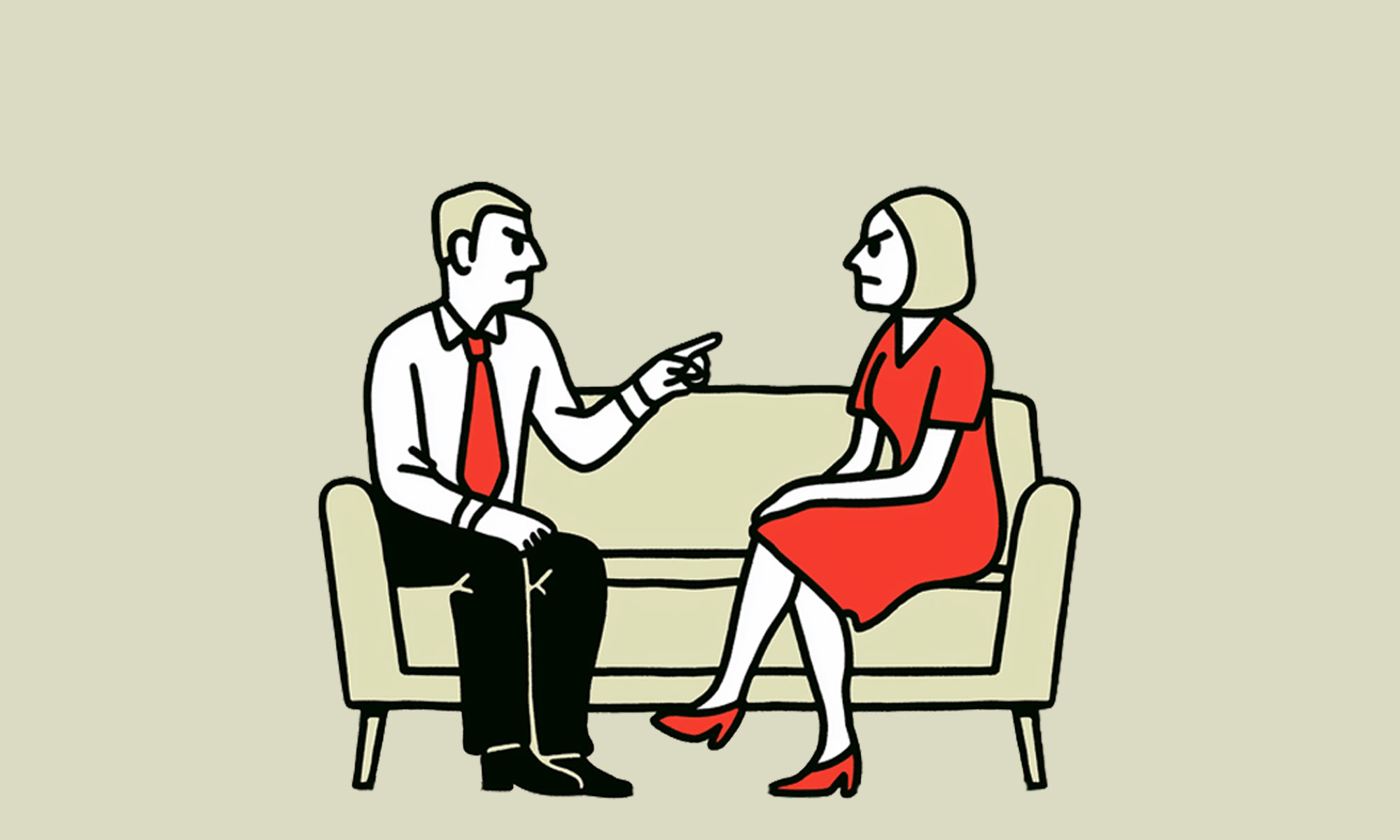
Criticising, controlling, gaslighting sometimes. When we see these kinds of behaviours in a relationship, it’s possible that they are OCD compulsions.
I think us therapists are getting better at spotting this too. When one partner is having intrusive thoughts. And asking, or demanding, assurance from their partner. To try to keep the thoughts at bay.
But there’s another obsessive compulsive pattern driving a lot of relationship conflicts. Particularly around partners’ pasts and their sexual values.
A pattern that gets far less attention than OCD, even though it’s just as common. And I’m not sure therapists are so good at spotting it.
It’s called OCPD – Obsessive Compulsive Personality Disorder
And if you’re thinking ‘no I’ve heard about that, that’s when you procrastinate all day and can’t get anything done and you’re really tight with money… that’s not me or my partner‘… then hear me out.
Because OCPD is widely misunderstood, and often shows up in the therapy room dressed as something else.
That something else might be your retroactive jealousy or ROCD. Your obsessive doubts about whether your partner is right for you.
I had a client – I called him Kelvin in a previous blog post – who came to see me, he said, “for the benefit of his wife”. He really didn’t think there was anything up with him.
His wife had a sexual past that she didn’t seem appropriately troubled by. And that was the problem, as far as Kelvin was concerned.
And that had me thinking OCPD.
We’ll come back to Kelvin. But first – what’s the distinction between OCD and OCPD?
OCD vs OCPD – the key difference
With OCD, the thoughts feel unwanted. Intrusive. Therapists call this ego-dystonic – meaning the thoughts feel counter to who you are, or what you believe or value.
I hate the thought that my partner is this or that, or I’m this or that.
OCPD is almost the opposite. The preoccupations feel consistent with who the person is. Their standards, their values, their identity.
It’s ego-syntonic – meaning it feels like me. I’m not disturbed by what I’m thinking, it feels right. The disturbance is what if it’s true – or other people won’t see it.
I don’t like the thought that my partner is this or that, or the way I respond to these thoughts, but it feels necessary. I’m standing up for who I am.
OCPD is also more pervasive than OCD. It’s not one specific theme or fear – it’s a way of moving through the world.
It can show up at work, with friends, in how someone loads the dishwasher. And of course, it shows up in intimate relationships.
Estimates suggest OCPD affects somewhere between 2 and 8 percent of the general population, and it’s more commonly diagnosed in men.
And yet hardly anyone’s talking about it, compared to OCD anyway.
The 4 Ps of OCPD: a framework for understanding the pattern
The four core traits of OCPD are: perfectionism, perception, productivity and projection.
And credit goes to therapist and OCPD specialist Brittni Capps for coming up with these four Ps. Her work is well worth exploring if this resonates.
Let’s take a look at how the four Ps show up in relationships.
Perfectionism
With OCPD, perfectionism isn’t just doing things well. It’s about there being one right way – and the discomfort, distress, infuriation of watching someone else do it differently.
Kelvin had strong views about how things should be done. Professionally and domestically.
This wasn’t arrogance exactly – it came from an internal standard that he held himself to as well. He worked hard, he did things properly, he was meticulous. And he found it difficult – really difficult – when his wife didn’t share that approach.
It might be something as mundane as stacking the dishwasher. Which sounds trivial until you’re the partner who can’t put a thing in it without getting corrected.
But perfectionism in OCPD isn’t just procedural. It extends to the moral too, and this is often where retroactive jealousy comes in.
Kelvin’s wife had a sexual past. She’d had casual experiences in her early twenties. She didn’t regret them.
And this, for Kelvin, was a significant problem. Not just because of the experiences themselves, but because she couldn’t or wouldn’t see them the way he did. As wrong. As something that needed acknowledging, addressing, setting right.
Kelvin wasn’t jealous. It was about a standard he held, that his wife had failed to meet – before she even knew him – and that she now refused to accept.
From the OCPD perspective: how do you move on from that? How do you accept a piece of work that was done badly and just… leave it?
You don’t. You keep going back to it. Because the standard demands it.
Perception
The second P is about how someone with OCPD tends to see themselves – and by extension, how they see everyone around them.
There’s a strong sense of identity here. The conscientiousness, the doing things properly – these aren’t just habits, they’re who I am. It’s my responsibility to stay on top of things.
You can probably already see how this plays out in relationships. The OCPD partner has a quiet – or not so quiet – contempt for what they perceive as their partner’s carelessness.
It might be angry contempt or just a tired ‘I suppose I’ll have to deal with this too‘. A sense of being the responsible one, surrounded by people who don’t get it.
And when it comes to the partner’s past, things can get pretty angry.
Casual sex, reckless dodgy decisions – that’s intolerable to me. Through this lens, my partner is the opposite of what I value in myself. Irresponsible. And worse.
This comes out in direct accusations or a low-level dissatisfaction – a withdrawal of full respect, a sense that my partner is someone I’m having to overlook something significant about. Which corrodes intimacy either way.
Productivity
Here’s the one that surprises people.
OCPD often means a deep discomfort with rest, leisure and anything that feels unproductive.
Work is where the OCPD person feels most at home – focused, purposeful, in control of the output. They may be highly successful professionally, well-regarded. Rewarded for being the way they are.
It’s the unstructured time that causes problems.
Kelvin mentioned – as an aside – that he spent a lot of time in his home office. Working, or at least in the controlled space of working. When he was deep in a project, the relationship pressure lifted actually. He had something to get his OCPD teeth into.
Weekends though. Bank holidays, leisure time with his wife. It felt, to Kelvin, like unstructured exposure. With no project to focus on, his mind turned to other unresolved things. A big one being his wife’s past.
You might notice something else with OCPD and productivity: all the researching.
When something feels unresolved in the relationship, the OCPD person will often throw themselves into understanding it. Books, articles, psychology, Reddit, YouTube. All in service of getting on top of the problem.
And up to a point, that’s positive. It’s a willingness to engage with a problem.
But it can be compulsive. Hours spent understanding attachment styles, or reading threads from people who validate their perspective.
And somewhere underneath: here I am doing all the work, to resolve what someone else did.
Which reinforces the perception problem – I’m the responsible one, while you just carry on as if it doesn’t matter.
Sometimes the productivity of OCPD is described as getting bogged down in the detail and defeating the purpose of the activity. Like spending so much time trying to find the perfect restaurant that it becomes tedious and we run out of time and we end up not going out for dinner.
But a lot of people with retroactive jealousy say “no, I don’t relate to that. I get things done – really well, actually“. And they do.
But sometimes this trait manifests in our relationship itself.
Getting so bogged down in it being right, our partner being right for us, things done properly past and present, it defeats the object of being in a relationship. Of having empathy and sharing your world with another person, with all the hopes and dreams that come with that.
OCPD just has all of that in tense gridlock, or has us out of the relationship – sooner or later.
Projection
The fourth P is where things can get difficult to hear. Because projection, by its nature, is hard to see in ourselves.
But in a nutshell: the discomfort that belongs to me gets placed outside me. Onto you. You’re the one with the problem. You’re the one who doesn’t care, doesn’t try, does things wrong, has poor values.
Again, this can be on a day-to-day domestic level – a sense that a partner is sloppy, or doesn’t really try. A constant state of irritation and nitpicking.
When it comes to a partner’s past or choices, it’s harsher than that.
The casual sex, the things they did that I wouldn’t have done – these get projected onto the partner as character failings. And certain labels that I’ve been advised not to say for risk of being de-Googled.
Words that come from a place of projected moral judgement rather than genuine assessment of the person in front of them. Sometimes, the manosphere has a lot to answer for.
What makes this painful is that most OCPD people – including Kelvin – are aware that this isn’t on. They see the harm their projections do.
But what’s the alternative? Stop doing what I do? Let it go?
That’s difficult, isn’t it. It comes back to me.
When OCPD looks like depression
It’s something that gets missed in discussions of OCPD, because the stereotype is of the controlling, irritable, demanding partner.
But there’s another version. When the strategies stop working – when the research doesn’t resolve anything, when the conversations go nowhere, when the relationship keeps failing to reach the standard – the OCPD person can go flat.
Not explosive, just deflated. Going through the motions. It can look like depression, and it shares some features with it.
But it’s the exhaustion of a person who’s been working too hard on something that can’t be completed. Who has tried to get everything in order and found that some things – a partner’s past, another person’s values, the irreversibility of time – can’t be put in order, no matter how much we try.
That’s when people end up in therapy. Not in a blaze of anger, but in a quiet, depleted kind of “I don’t know what else to do“.
If you recognise OCPD in yourself
Well, a couple of things to consider.
The traits that create problems in relationships are often the same traits that work really well for you elsewhere. Conscientiousness, high standards – these aren’t flaws. They’re part of who you are, and how you achieve things.
It’s not about ditching these aspects of yourself. You can’t anyway.
The therapy that actually helps here isn’t the kind that tries to reason you into a different position. The question is more: how did this particular way of thinking develop? What’s driving it in this situation?
And could there be some flexibility here – without losing what’s genuinely good about you?
That’s slow work sometimes. Small steps. Starting with the dishwasher.
And one more thing. If your partner has OCPD tendencies, the same applies to you – this isn’t about winning the argument or getting them to see it your way. Understanding what’s underneath it is a better place to start.
I hope this is helpful. And I’ll have more to come on this topic; I think it deserves a bit more attention.