Couples affected by retroactive jealousy need to be in agreement.
Not agreement that it was regrettable or wrong or shouldn’t have happened. And definitely not agreement on all the past details.
But agreement that the questions and endless conversations about the past need to stop.
If you’re a partner living with someone who has retroactive jealousy, you know what these situations look like. I know what we said… but can I just ask..?
Sometimes you can hold firm, respectfully saying to your partner: don’t forget what we agreed.
But some situations are harder to hold a line on. When your partner doesn’t just want to ask. They demand. They feel justified asking, digging, dragging it all up again. That’s the kind of situation I’m addressing in this blog post.
Two ways an agreement falls apart
Just to be clear, there are two different ways the agreement falls apart. And they’re not the same problem.
A lot of people experience retroactive jealousy as OCD-like loops: a trigger or a thought about their partner’s past, a whoosh of bad feeling and a need to ask or get assurance.
They’ve agreed not to ask or seek assurance. But the thought or the feeling is hitting them so hard, so specifically, it feels like this time it’s different, I need to ask this time. This is confusion in the moment, not realising that it’s the same pattern, the same loop.
But what I’m talking about today is a different, tougher scenario. It’s when the mention, question or criticism of your past feels… perfectly OK to say.
And that’s a different problem. Because you can’t remind or nudge someone who thinks their doubt is reasonable rather than obsessional on their part.
When it’s more OCPD than OCD
We’re talking more OCPD-flavoured retroactive jealousy than OCD here.
And this gives us agreement challenges in two ways.
There isn’t really any agreement
You try to have the conversation about boundaries and not dragging up your past. And it doesn’t land.
Your partner doesn’t see why they’d agree to that. It’s a reasonable thing to want to know, they say. Why would I sign up to not asking, not getting all the info?
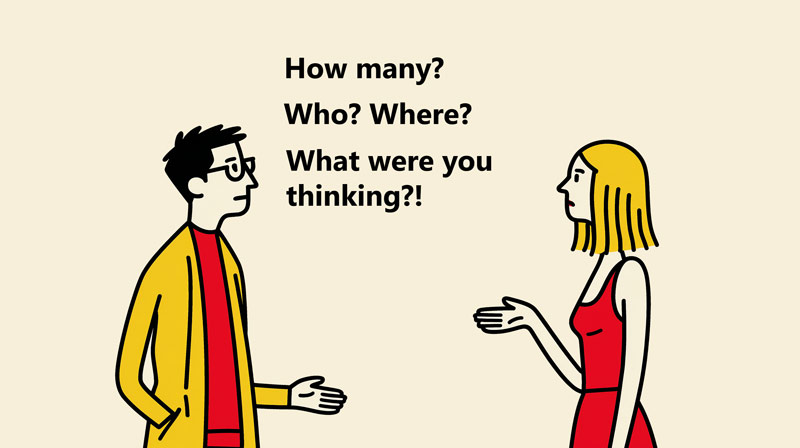
Any conversation about how we handle this going forward leads to them setting the terms. Just tell me and I’ll be alright, we’ll be alright.
But it’s never alright. This kind of agreement denies that the partner asking the questions is stuck in a loop. And the interrogation continues.
The letter of the agreement, but not the spirit
This one’s sneakier. Your partner agrees: no more questions about the past. And they may well mean it. They get it. All these questions about your sexual past are intrusive, shaming even.
But then the assurance-seeking shifts from so what happened with that guy to do you still think about it or ok no details but… do you regret it…?
Or a joke about all those that came before me or a hypothetical – I saw something online about a woman who did this or that, what do you think about that? Just interested…
Of course, this is still assurance seeking. Or trying to impose our own way of seeing things – just though a side door now.
Both versions of this problem leave you in the same place: trying to hold a boundary that either doesn’t exist or has wriggle room. Retroactive jealousy exploits wriggle room, over and over.
Why this happens
It’s worth understanding why this is harder with OCPD traits, because it changes how you approach it.
This isn’t your partner being difficult for the sake of it. There’s a real need underneath the behaviour: clarity, order, a sense that things are properly resolved and accounted for.
It’s not I enjoy interrogating my partner. It’s more loose ends are intolerable and I’m trying to get peace of mind – for me and ultimately for us both.
So agreeing to stop feels like going against nature. You’re asking me to tolerate a mess, a discrepancy?
This understanding doesn’t make the impact on you any less painful, I know.
But it can help to know that you’re dealing with someone who genuinely feels like these questions are getting them somewhere, are leading to some kind of greater good. It’s a different form of confusion.
Building an agreement that actually holds
So what do you do, if you’re the partner trying to get some kind of workable agreement in place?
Start with the why. Both of you need to be really clear on why you’re doing this.
It’s not we don’t talk about this because it’s forbidden or this will always be off limits, get used to it.
Try something closer to: have you noticed that talking about the past actually makes the tension worse? We both want this to get better, right? Are we willing to try a different approach?
That’s more in line with what you’re both looking for here; it’s about effectiveness, being pragmatic rather than sucking up the anxiety of not knowing. It could speak to the OCPD mindset more.
Expect the boundary to get tested sideways. If you hear I’m not asking about him, I just want to know we’re on the same page – you’re allowed to notice that and name it, gently.
I hear that you want reassurance right now. I’m not going to give it this way, though. Let’s do something else.
Hold the line with warmth, not with silence. This is probably the hardest bit.
If your partner says but I’m struggling right now and you just say no, we don’t do this – they can end up feeling not just unassured but ignored.
Try to make room for both: I can see you’re finding this hard right now. I’m still not going to answer that question. Come sit with me for a bit. You’re meeting their distress without meeting the compulsion.
Remember the agreement isn’t the finish line.
We’re not trying to make a fixed no-go zone in the relationship. We’re doing this to take the pressure off enough so your partner gets to do their part of the work. Coming back to the here and now, being present themselves, feeling the discomfort. Without leaning on you to make it go away.
All of this should matter less over time, if it’s holding and the work is happening. Ideally with your partner doing some therapy or following a self-help plan. Having some willingness to change things up for the better.
When there’s no agreement to be had
Sometimes, none of this gets off the ground.
Your partner won’t do it, sees no reason to and any attempt at agreement turns into them explaining why their questions are fair because of how your past makes them feel.
At that point, a few things worth trying: get a therapist involved, ideally with all three of you in the conversation, at least initially. Get your own support too, whether that’s with a therapist or trusted people around you.
And be honest with yourself about willingness here. If there really isn’t any on your partner’s part, not even to consider that this might be a pattern worth looking at, that’s important information. You should probably consider your options.
One more thing worth flagging: if any of this tips into something more volatile like rage, threats, that kind of intensity, that’s a different situation too. See my post on where RJ can tip over into something else entirely.
Where this leaves you
So yes, those times when your partner says I know I shouldn’t ask perhaps, but this time it’s different…
With OCD-flavoured retroactive jealousy, that’s a moment where you can gently remind and hold firm.
With OCPD traits, it’s about being clearer upfront about how this is going to work. Not hammering out a complicated contract, but being really sure that you both agree why you’re doing it.
Protecting the relationship long enough for your partner to be more on their own two feet with their own values and discomforts, so they can stop treading on yours.
So they can be more present, and ultimately need your assurance less and less. It’s not easy, but I do see couples get there.